


A few days ago I spent an hour with the general counsel of a fast-growing investment firm. She’s also their chief compliance officer, and for her first three years she was the entire legal department. Ten minutes in, she described her contract situation better than I ever have.
When she joined, she inherited some of the worst filing she’d seen in her life. Some files were password-protected, and nobody had the passwords. The team figured out who their vendors were by looking at who they’d paid the year before. It took her, the COO and the CFO about three years to feel like they’d found every problem.
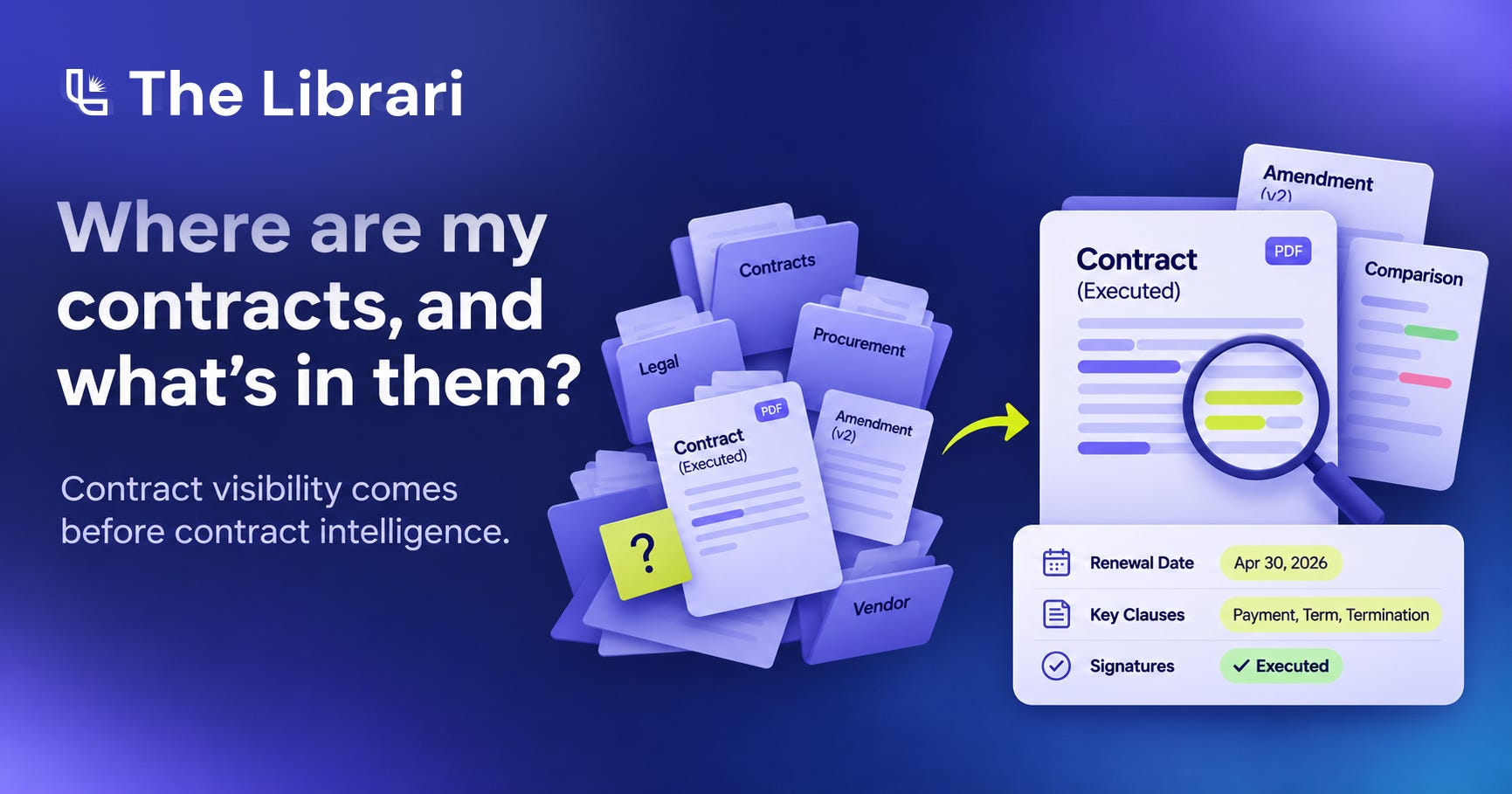
If that sounds familiar, you’re not alone. It’s the first question almost every new GC, CFO or CEO asks when they walk in the door: where are the contracts, and what do they say?
The signed copy is always the one you can’t find
Her biggest frustration is simple. She can find the unsigned version of almost anything. The fully executed one is another story.
Banks and counterparties rarely send back a clean signed copy. Then a new amendment shows up and she realizes she doesn’t have the agreement it’s amending. One counterparty folder has around 50 documents spread across eight subfolders, and when a question comes up about which agreement covers a certain kind of trade, she often has no idea which document to open.
Then there was the time a counterparty took a PDF she’d already signed, edited a clause, signed it and sent it back. It cost the firm roughly $1 million. If you know exactly what you sent and can compare it to what came back, that’s a five-minute check. If you’re digging through version folders, it’s a mistake nobody catches until it’s expensive.
Memory is not a system
A lot of the firm’s contract knowledge lives in her head. She remembers every deal she’s worked on. She can’t remember anything that predates her, because she wasn’t there.
So when a new agreement comes in from an affiliate in another country, she’s checking it against existing terms from memory, or paying outside counsel to do it. She estimated that checking a new agreement against everything already on file would save her about $80,000 a year in outside counsel fees on that work alone.
Her regulators also expect her to be able to lay out the key provisions in every counterparty relationship: notice periods, collateral triggers, the things that matter on a bad day. That’s a hard request when documents are filed by year instead of by party, and a 2021 master agreement sits three folders away from the amendment you signed last spring.
Knowing first, then everything else
She’s been trying to build a clause library with AI, which is a great goal. She wants the same limitation of liability language across her agreements and to know which contracts don’t follow it. But she kept hitting the same wall. You can’t build a clause library from contracts you can’t find, can’t name, or only have half of.
I see the same order of operations with our customers. Before the clause library or the AI drafting, you need to know what you have and where it lives. Once you do, a lot of things that felt impossible get easy:
Deadlines stop sneaking up on you, because the renewal and notice dates are pulled out and in front of you.
Invoices can be matched to the contract they should follow. One vendor bills each entity separately every month, and neither she nor the CFO can tell which charge maps to which agreement.
New agreements get checked against what you’ve already agreed to, so you know what to push back on.
Missing signatures show up before they become a dispute.
Why this matters
At my last company, we spent $1.7 million and thousands of hours on one of the big contract management systems. It never really worked. That’s a big part of why we started Librari. She’d seen it from the buyer’s side: most legal tools are built for law firms or the Fortune 500, and they come with a hundred features she’d never use. She just needed to find her contracts and know what they contained.
Not knowing what’s in your contracts is the risk. When knowledge lives in one person’s head and a pile of folders sorted by year, every new agreement, invoice and audit request costs more time and money than it should.
Near the end of the call, she said what she wanted most was to take everything in her head and organize it somewhere she could actually see. That’s a pretty good description of the job.
If you’re sitting on years of contracts you inherited and aren’t sure what’s in them, I’d love to hear what you’re running into.
-T.J.