

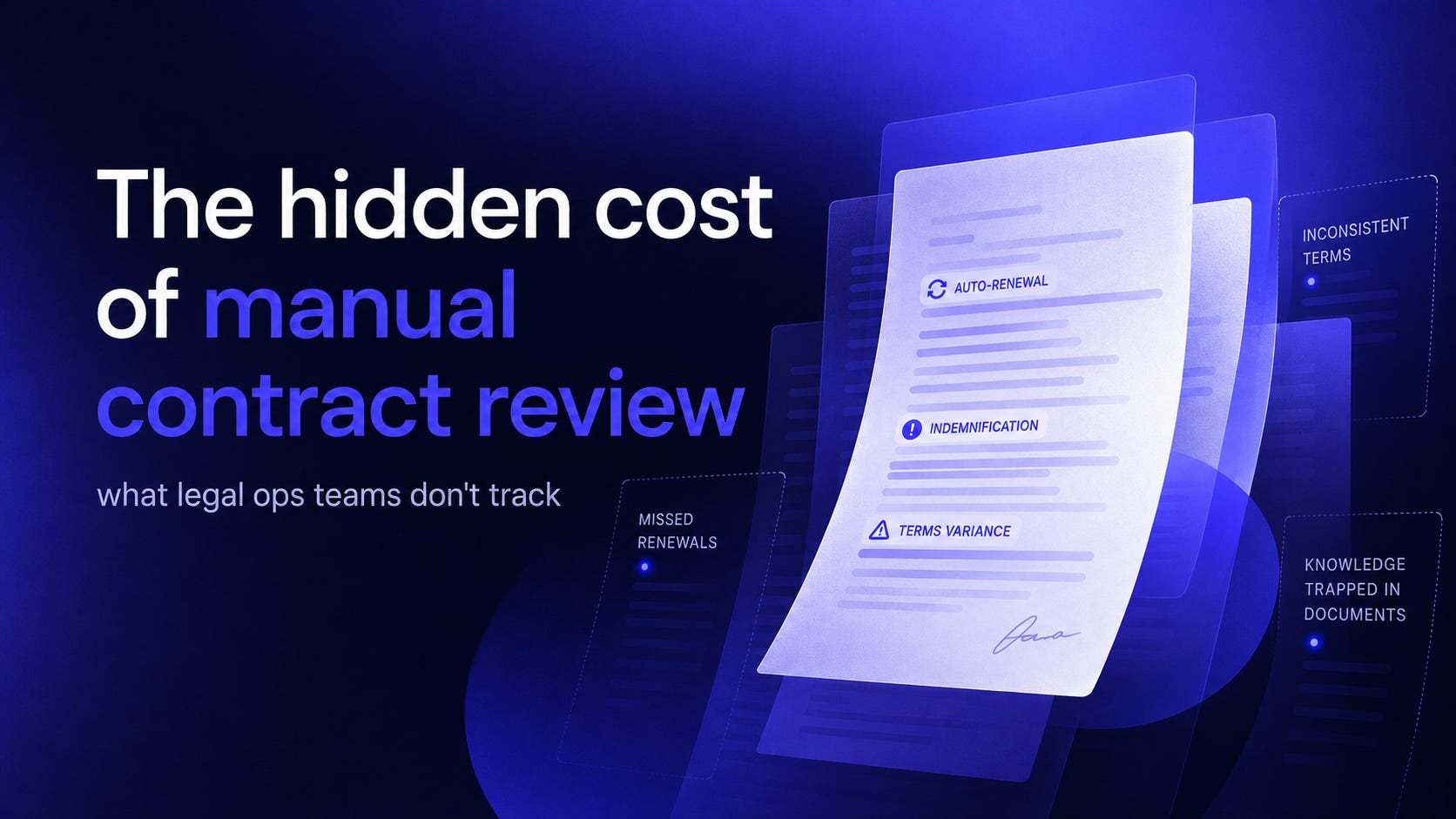
Ask a legal ops lead what manual contract review costs and you will usually get an answer about time. Hours spent reading. Turnaround days on a redline. Headcount on the team. Those numbers are real, and they are the smallest part of the bill.
The expensive part of manual review is the part nobody tracks, because manual processes are, by definition, bad at measuring themselves. Here is what hides in that gap.
The cost of what you never find
Manual review can only examine the contract in front of you. It is structurally blind to the contracts no one pulled up. So the duplicate vendor agreement in another department goes unnoticed. The auto-renewal three folders deep rolls over. The risky indemnity that appears in forty agreements is never seen as a pattern, because no human reads forty agreements side by side. None of this shows up in a time log. It shows up later, as money, in a form that is hard to trace back to its cause.
The cost of inconsistency
When review depends on who happened to do it, standards drift. One reviewer flags a liability cap, another waves it through. One catches a missing notice provision, another does not. Over hundreds of agreements that variance becomes real exposure, and it is invisible because there is no record of what each reviewer chose to ignore. Manual review does not just miss things. It misses them unevenly, which is worse, because you cannot even predict where the gaps are.
The cost of knowledge that walks out the door
In most teams, the real contract database is a person. The ops lead who knows which agreements matter, where the bodies are buried, which renewals to watch. That knowledge is enormously valuable and completely undocumented. When that person takes leave, changes roles, or leaves, the company does not lose a file. It loses its memory. That cost never appears on a budget line, but anyone who has lived through it knows exactly how much it hurts.
The cost of slow answers
There is a quieter tax that compounds daily. Every time someone asks “are we allowed to do this under the agreement,” “when can we exit,” or “what did we commit to here,” the answer requires a person to stop, find the document, and read it. Multiply that by every such question across a year and you have a meaningful drain that never gets attributed to manual review, because each instance is small. It is death by a thousand lookups.
Why this stays hidden
All of these costs share one trait: they are costs of absence. Missed things, inconsistent things, forgotten things, slow things. Absences do not generate invoices. They do not trigger alerts. They surface as a surprise renewal, a failed diligence process, a bad clause discovered too late. By the time they are visible, they no longer look like a review problem. They look like bad luck.
That framing is the trap. It is not bad luck. It is the predictable output of a process that can only ever see one document at a time.
What changes with structure
The fix is not to read faster. It is to stop relying on reading as the system of record. When every agreement is read once, structured into consistent fields, and held in one visible place, the hidden costs stop being hidden. Duplicates become findable. Patterns across the portfolio become obvious. Critical dates become data that can trigger an alert instead of facts that depend on memory. Answers take seconds, because the work of extraction happened once, up front, rather than every time someone asks.
This is the work we built Librari to do, and we kept it inside Google Drive so it forms around the contracts a team already has rather than asking them to start over. But the deeper point holds regardless of tool. As long as your system of record for contracts is “a person reads the document,” you are paying these costs whether or not you can see them on a spreadsheet.
The takeaway
If you want to know what manual review really costs, do not count the hours. Count the things you cannot count: the contract you did not find, the clause you flagged in one place and missed in another, the date that depended on someone’s memory. Those are the line items that matter, and they are precisely the ones a manual process can never put a number on.